Proposition 13 sets the foundation for every California commercial property tax bill, and understanding it is the first step to knowing whether you are overpaying.
If you own commercial real estate in California, Proposition 13 is the single most important law governing your property tax bill. It determines how your property is valued, how much your taxes can increase each year, and when the assessor can reassess your property at current market value.
Most commercial property owners have a general sense of what Proposition 13 does. It limits property taxes. But the details matter enormously, because understanding how Proposition 13 works for commercial property is what allows you to identify when you are being overcharged and what you can do about it.
This guide explains what a commercial property owner needs to know about Proposition 13: how it works, when it triggers a reassessment, how it interacts with Proposition 8 (the decline in value provision), and what it means for your property tax appeal rights.
What Is Proposition 13 and How Does It Affect Commercial Property?
Proposition 13 is a California constitutional amendment passed by voters in June 1978. It fundamentally restructured how property taxes work in California by establishing three core rules:
- Property tax rate cap. The general levy property tax rate is capped at 1% of assessed value, plus any voter approved bonds and special assessments, which typically bring the total rate to approximately 1.1% to 1.3% depending on the jurisdiction.
- Annual assessment increase cap. The assessed value of a property can increase by no more than 2% per year (or the rate of inflation, whichever is lower), as long as the property does not change ownership or undergo new construction.
- Reassessment triggers. The assessed value is reset to current market value only when a change in ownership occurs or when new construction is completed.
Before Proposition 13, California property taxes were based on current market value and could increase dramatically year over year as real estate values rose. Proposition 13 replaced that system with a base year value approach. Your property is assessed at its value at the time of purchase, and that value grows slowly over time under the 2% annual cap.
How Proposition 13 Assessments Work: The Base Year Value System
When you purchase a commercial property in California, the county assessor establishes a base year value equal to the purchase price, or more precisely the full cash value at the time of the change in ownership. This becomes the starting point for your property tax assessment.
From that point forward, your assessed value can increase by no more than 2% per year, regardless of what happens to market values. If you bought a warehouse in 2010 for $3 million, your 2025 assessed value, assuming no change in ownership or new construction, would be approximately $3 million multiplied by 1.02 to the fifteenth power, or roughly $4.04 million.
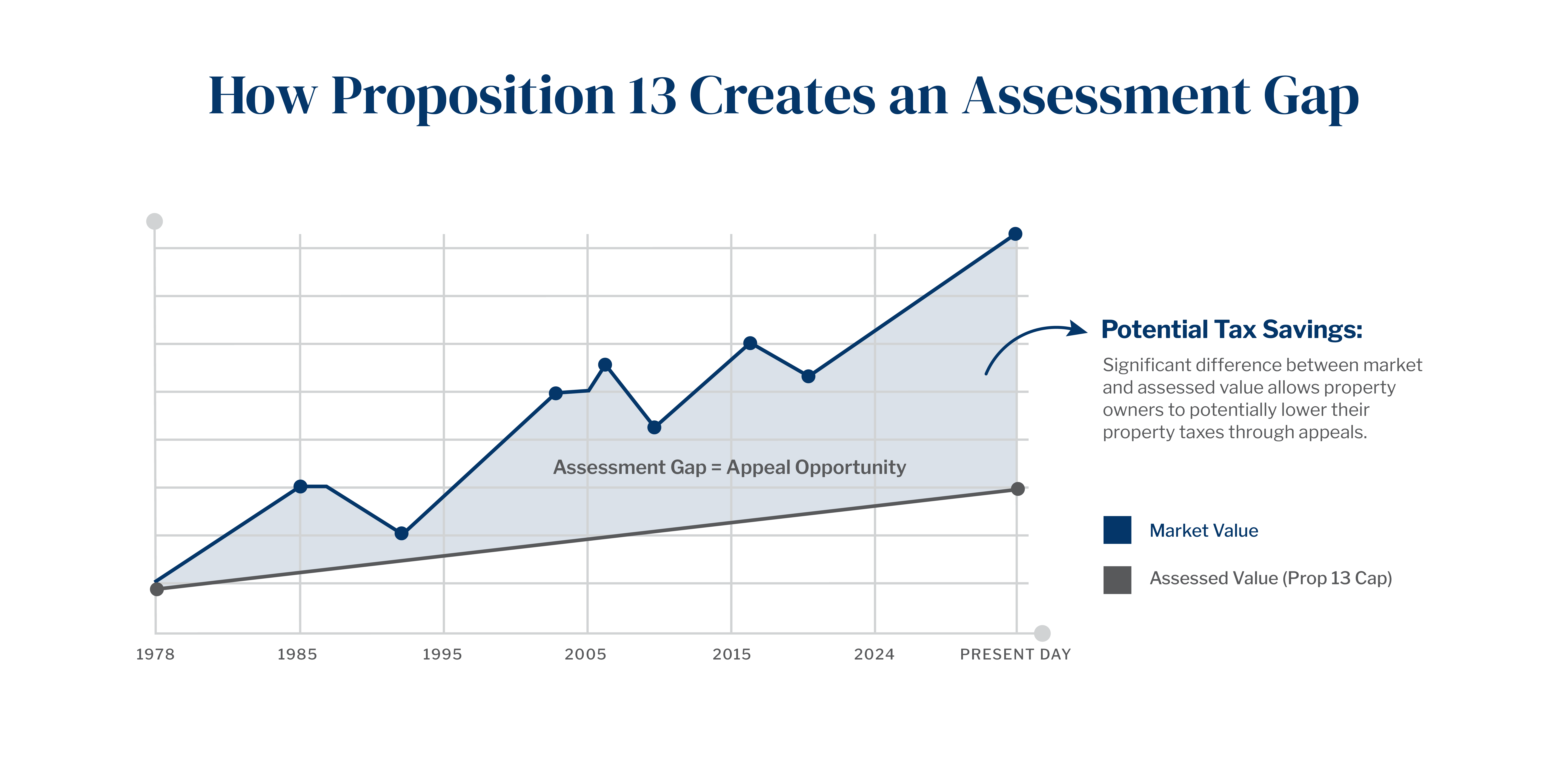
Here is what makes Proposition 13 so significant for commercial property owners: California commercial real estate values have historically appreciated far faster than 2% per year. In many markets, properties purchased a decade or more ago have market values that are two, three, or even four times their Proposition 13 assessed value.
This creates a substantial tax advantage for long term owners, and it is one of the primary reasons California commercial property is so attractive to hold.
When Does Proposition 13 Trigger a Reassessment?
The 2% annual cap holds until one of two events occurs: a change in ownership or new construction. Either event triggers a reassessment at current market value, resetting the base year value.
Change in Ownership
A change in ownership is the most common reassessment trigger. When a commercial property is sold, the assessor reassesses it at the purchase price, or at current market value if the purchase price does not reflect an arm's length transaction.
But change in ownership is more nuanced than it sounds. Under California law, certain transfers do not trigger a reassessment:
- Transfers between spouses, including domestic partners
- Transfers to a revocable living trust where the transferor is the beneficiary
- Certain transfers between parents and children, subject to limitations under Proposition 19
- Transfers of a controlling interest in a legal entity that owns real property, but only if the transfer does not result in a single person or entity owning more than 50% of the entity
This last point is particularly important for commercial real estate investors who hold properties through LLCs, partnerships, or corporations. Structuring ownership transfers carefully can sometimes avoid a full reassessment, though this is a complex area of law that requires professional guidance.
New Construction
New construction, including additions, renovations, and improvements, triggers a reassessment of the newly constructed portion only. The existing base year value is not affected. Only the value of the new construction is added at current cost.
This means that if you add a new building on a parcel, the existing land and any existing structures retain their Proposition 13 base year value, while the new construction is assessed at its current market value.
Proposition 8: The Decline in Value Provision
Here is where Proposition 13 creates an important opportunity for commercial property owners, and where most property tax appeals originate.
Proposition 8, passed in 1978 alongside Proposition 13, added a provision to the California Constitution that requires the assessor to enroll the lower of two values each year:
- The Proposition 13 base year value, adjusted for the 2% annual cap, or
- The property's current market value as of January 1
This means that if market values drop below your Proposition 13 assessed value, you are entitled to a temporary reduction in your assessed value to reflect current market conditions. This is called a Proposition 8 reduction, or a decline in value reduction.
The key word is temporary. Unlike a base year value reduction, a Proposition 8 reduction is reviewed annually. If the assessor determines that market values have recovered, your assessed value can be restored to the Proposition 13 base year value, potentially in a single year, with no 2% cap on the increase.
For commercial property owners, Proposition 8 is the most common basis for a property tax appeal. It is most relevant when:
- Office or retail values have declined due to rising vacancy, falling rents, or market disruption
- Industrial or multifamily values have softened due to cap rate expansion or local market conditions
- A property has specific issues such as deferred maintenance, functional obsolescence, or below market leases, that reduce its value below the assessed level
Proposition 13 and Commercial Property: Key Differences from Residential
While Proposition 13 applies to both residential and commercial property, there are important differences in how it plays out in practice for commercial owners.
Higher stakes per property. Commercial properties typically have much higher assessed values than residential properties, which means the dollar impact of an over assessment is proportionally larger. A 15% over assessment on a $10 million commercial property represents $1,500,000 in excess assessed value and roughly $18,000 in annual overtaxation at a 1.2% rate. That is worth pursuing.
Income approach valuation. For income producing commercial properties, the appeals board uses the income approach to value, capitalizing the property's net operating income at a market cap rate, rather than relying primarily on comparable sales. This creates a different evidentiary framework than residential appeals.
Change in ownership complexity. Commercial properties are frequently held in legal entities such as LLCs, partnerships, and corporations, which creates complex change in ownership questions that do not arise with residential property. Understanding when an entity level transfer triggers a reassessment requires careful analysis.
Business personal property. Commercial property owners are also subject to California's business personal property tax, a separate annual assessment on equipment, fixtures, and other tangible personal property used in a business. This is assessed entirely separately from real property and has its own appeal process.
The Proposition 13 Base Year Value Appeal
Most property tax appeals are Proposition 8 appeals, arguing that current market value is below the Proposition 13 base year value. But there is another category of appeal that is less well known and potentially more valuable: the base year value appeal.
A base year value appeal challenges the assessed value that was established at the time of purchase or new construction. If the assessor set the wrong base year value, for example by including non real property value in the assessment, or by incorrectly valuing the property at the time of purchase, you can appeal that base year value directly.
Base year value appeals are particularly relevant in these situations:
Purchase price included non real property value. If you purchased a property as part of a business acquisition, and the purchase price included goodwill, equipment, or other assets that are not real estate, the assessor may have incorrectly attributed the full purchase price to the real property. A base year value appeal can separate out those components.
The property was incorrectly reassessed after a change in ownership. If the assessor reassessed a property that should have been excluded from reassessment, for example a transfer that qualified for a parent child exclusion, a base year value appeal is the mechanism to correct it.
New construction was overvalued. If the assessor overvalued the cost of new construction, a base year value appeal can reduce the assessed value of the improvement.
Base year value appeals are subject to different deadlines than regular Proposition 8 appeals. You generally have four years from the date of the assessment to file a base year value appeal, compared to the annual filing window for Proposition 8 appeals. The rules are complex, and it is worth consulting with a property tax professional to understand your specific situation.
How Proposition 13 Interacts with Your Property Tax Bill
Your annual property tax bill is calculated as follows:
Assessed Value × Tax Rate = Annual Property Tax
The tax rate is composed of the following:
| Component | Typical Rate |
|---|---|
| Proposition 13 general levy | 1.00% |
| Voter approved bonds | 0.1% to 0.3% |
| Special assessments | Varies by jurisdiction |
In most California jurisdictions, the effective total tax rate for commercial property falls between 1.1% and 1.3% of assessed value.
Here is a quick reference for how assessed value reductions translate to annual tax savings:
| Assessed Value Reduction | Annual Tax Savings (at 1.2% rate) |
|---|---|
| $500,000 | $6,000 |
| $1,000,000 | $12,000 |
| $2,000,000 | $24,000 |
| $5,000,000 | $60,000 |
| $10,000,000 | $120,000 |
These savings are permanent, until the next reassessment event, and not just for the year of the appeal. A successful appeal that reduces your assessed value by $2 million saves you $24,000 every year going forward.
What Proposition 13 Means for Your Appeal Rights
Understanding Proposition 13 is the foundation for understanding your property tax appeal rights. Here is the key framework:
You have the right to appeal every year. During the annual filing window, July 2 through September 15 or November 30 depending on your county, you can file an appeal arguing that your property's current market value is below the Proposition 13 assessed value.
The assessor must enroll the lower value. Under Proposition 8, if current market value is below your Proposition 13 base year value, the assessor is legally required to reduce your assessed value. An appeal is the mechanism to enforce this right if the assessor does not do so voluntarily.
Refunds are available for prior years. If you have been overpaying because your assessed value exceeded market value, a successful appeal entitles you to a refund of overpaid taxes, plus interest, going back to the date of your filing.
The process is accessible. You do not need an attorney to file a California property tax appeal. The process is designed to be accessible to property owners, and many successful appeals are handled by property tax consultants or by owners themselves.
For a complete walkthrough of the appeal process, see our guide on how to appeal commercial property taxes in California. For deadlines specific to your county, see our California property tax appeal deadlines guide.
Frequently Asked Questions
Does Proposition 13 apply to commercial property the same way it applies to residential property?
Yes. Proposition 13 applies to all real property in California, including residential, commercial, industrial, and agricultural. The same 1% tax rate cap, 2% annual increase cap, and reassessment on change of ownership rules apply to commercial property. The main differences are in how commercial properties are valued, income approach versus sales comparison, and the complexity of change in ownership rules for entity held properties.
What happens to my Proposition 13 base year value when I sell my commercial property?
When you sell, the new owner's base year value is reset to the purchase price. Your Proposition 13 base year value does not transfer to the buyer. It terminates with the change in ownership.
Can I appeal my commercial property taxes even if I recently purchased the property?
Yes, but the basis for your appeal is different. If you recently purchased the property, your assessed value should equal your purchase price, assuming an arm's length transaction. If the assessor set a higher value, you have a base year value appeal. If the market has declined since your purchase, you may have a Proposition 8 appeal.
What is the difference between a Proposition 8 appeal and a base year value appeal?
A Proposition 8 appeal argues that current market value is below the Proposition 13 assessed value. It is a temporary reduction tied to current market conditions. A base year value appeal challenges the assessed value that was established at the time of purchase or new construction. It is a permanent correction to the base year value. Both types of appeals are filed using the same form, BOE-305-AH, but have different evidentiary requirements and timelines.
How does Proposition 19 affect commercial property?
Proposition 19, passed in November 2020, primarily affected residential property tax transfers between parents and children. For commercial property, Proposition 19 did not change the fundamental Proposition 13 rules. Commercial property still triggers a full reassessment on change of ownership, and the parent child exclusion that existed under prior law no longer applies to commercial property inherited from parents.
Is Your Commercial Property Over Assessed Under Proposition 13?
The most common scenario where commercial property owners are overpaying is when market values have declined below the Proposition 13 assessed value and the assessor has not proactively reduced the assessment. This happens more often than most owners realize, particularly in markets that have experienced office or retail softness.
If you are not sure whether your property qualifies for a reduction, the fastest way to find out is a free evaluation from a property tax professional. Paramount Property Tax Appeal reviews your current assessment at no cost and gives you an honest assessment of whether an appeal is worth pursuing, with no obligation and no upfront fee.
Related Resources
- Commercial Property Tax Appeal California: The Complete Guide
- How to Appeal Commercial Property Taxes in California
- California Property Tax Appeal Deadlines: County by County Guide
- What Is a Contingency Fee Property Tax Appeal?
Sources: California Board of Equalization, Publication 29: California Property Tax Overview · California Constitution Article XIII A (Proposition 13) · California Board of Equalization, Proposition 8 Decline in Value · NBER, The Lock-in Effect of California's Proposition 13

.png?width=170&height=64&name=Logo%20320x120(2).png "Logo 320x120(2)")