
A well prepared presentation to the Assessment Appeals Board is the culmination of weeks of evidence gathering, and the moment that determines your outcome.
Filing the appeal is the easy part. Knowing how to prepare for a property tax appeal hearing is where most property owners either win or lose. A presentation that actually persuades a board requires organization, credible data, and a clear understanding of the process.
KEY TAKEAWAYS
- California Assessment Appeals Boards are made up of three appointed citizens, not judges, and they respond to organized data rather than emotional argument.
- The property owner presents first and carries the burden of proof, which is a preponderance of the evidence rather than proof beyond a reasonable doubt.
- Most counties require evidence exchange with the assessor 10 to 15 days before the hearing, and missing that deadline can result in your evidence being excluded.
- Commercial hearings typically run 30 to 90 minutes, and written decisions arrive within 30 to 60 days when the board takes the matter under submission.
- Many appeals settle informally with the assessor before the hearing, often after a strong evidence exchange.
California Assessment Appeals Boards hear hundreds of cases each year. Board members are experienced, and they have seen every type of evidence, every valuation argument, and every presentation style. What impresses them is not drama or emotion. It is organization, credibility, and well supported data.
If you are preparing for an upcoming hearing, whether you are representing yourself or working with a consultant, this guide walks you through the preparation step by step.
Understanding the Hearing Format
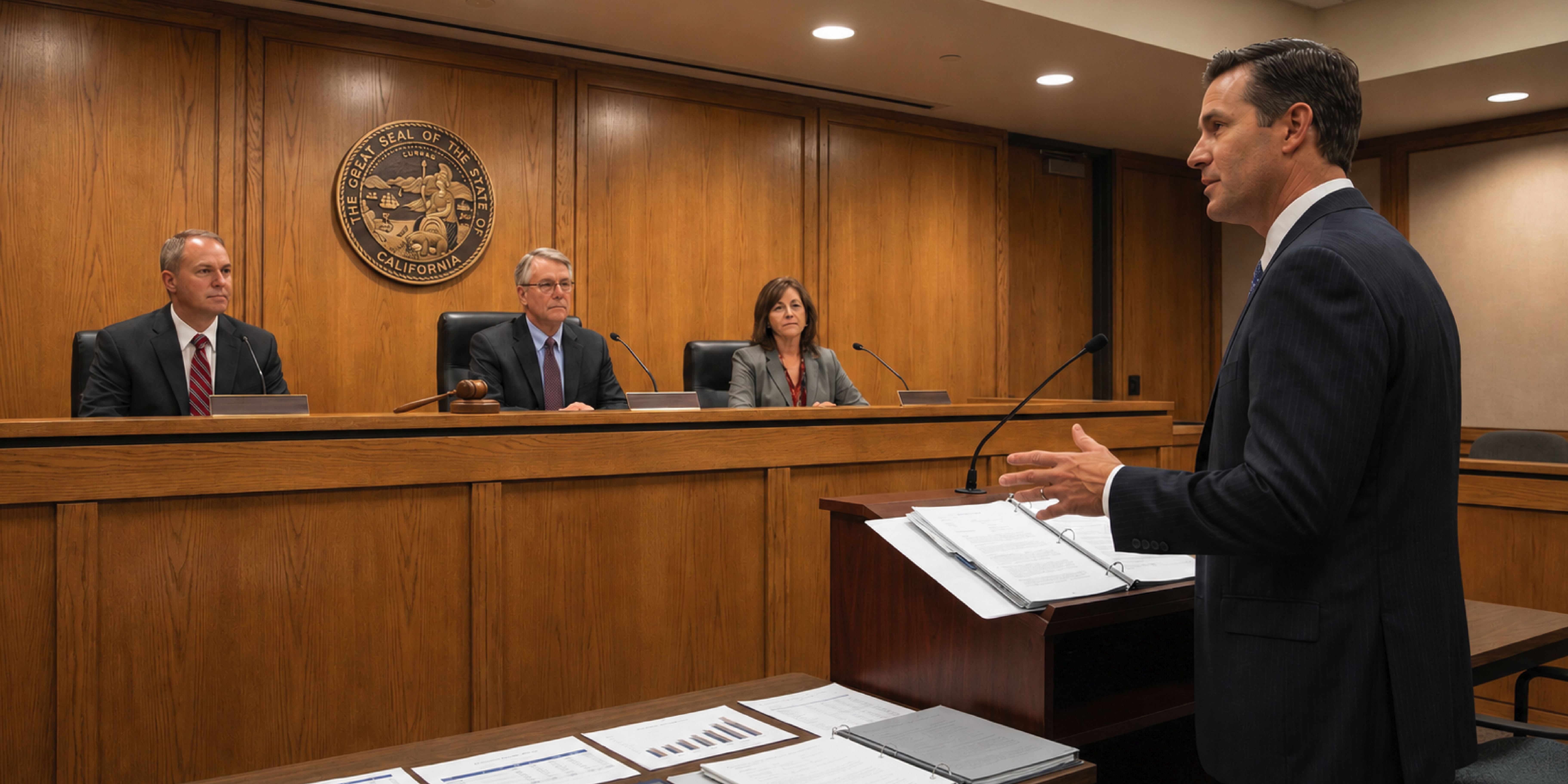
A California Assessment Appeals Board hearing is an evidence based proceeding before three appointed citizens, in which the property owner presents first and the county assessor's representative responds.
The board. Most California counties use a three member Assessment Appeals Board composed of appointed citizens rather than judges or attorneys. Board members are typically real estate professionals, appraisers, accountants, or business owners. They are knowledgeable but not specialists in property tax law.
The parties. The hearing involves you as the appellant, the county assessor's representative, who is typically a staff appraiser, and the board. Both sides present evidence and can ask questions of the other side.
The format. You present first, since you bear the burden of proof. The assessor's representative then responds. You may have an opportunity for rebuttal. Board members ask questions throughout.
The time. Commercial property hearings typically run 30 to 90 minutes, depending on complexity. The board may issue a decision at the hearing or take it under submission and mail a written decision later.
The standard. The board must find that your evidence preponderates, meaning it is more likely than not that the assessor's value exceeds fair market value. You do not need to prove it beyond a reasonable doubt, but you do need more than a general claim.
How to Prepare for a Property Tax Appeal Hearing: The 30 Day Timeline
The best way to prepare for a property tax appeal hearing is to work backward from the hearing date on a structured timeline: confirm the hearing at 30 days, organize evidence at 21 days, exchange evidence at 14 days, and finalize the presentation at 7 days.
30 Days Before: Confirm the Hearing and Review the Rules
As soon as your hearing date is scheduled, do the following:
- Confirm the hearing date, time, and location with the county Clerk of the Board. Hearings can be rescheduled, so do not assume the date you were originally given is still current.
- Review your county's specific hearing procedures. Each county has its own rules for evidence submission, number of copies required, and hearing format. Download the county's hearing procedures document from the Clerk of the Board's website.
- Request the assessor's evidence package. In most counties, you can request the assessor's evidence before the hearing. This tells you what value they are defending and what evidence they plan to use, which is invaluable for preparing your response.
21 Days Before: Gather and Organize Your Evidence
This is the core preparation work. For a commercial property, your evidence package should include the following.
Comparable sales. Three to five recent arm's length sales of similar commercial properties in your submarket, adjusted for differences in size, age, condition, and location. Source these from CoStar, county assessor records, or a licensed appraiser.
Income and expense data. For income producing properties, provide rent rolls as of January 1 of the tax year, operating expense statements, market vacancy data, and market cap rate support.
Property specific evidence. Photographs documenting physical condition, deferred maintenance, or functional issues, along with any inspection reports, contractor estimates, or environmental assessments.
Market reports. Published market reports from CBRE, JLL, Cushman & Wakefield, or similar sources documenting market conditions in your submarket as of the lien date.
Organize everything into a tabbed binder with a table of contents. Label each exhibit clearly, such as Exhibit A and Exhibit B. The board will follow along with your binder during your presentation, so make it easy for them to find what you are referencing.
For a detailed breakdown of evidence types and how to gather them, see our guide on what evidence you need to win a property tax appeal.
14 Days Before: Exchange Evidence with the Assessor
Most California counties require you to exchange evidence with the assessor's office 10 to 15 days before the hearing. Check your county's specific requirement, because this is a hard deadline.
Evidence exchange means providing the assessor's office with a complete copy of everything you plan to present at the hearing. In return, you should receive their evidence package if you have not already.
Failure to exchange evidence on time can result in exclusion of your evidence at the hearing. This is one of the most common and costly mistakes in do it yourself appeals. Do not miss this deadline.
After receiving the assessor's evidence, review it carefully and answer these questions:
- What value are they defending?
- What comparable sales are they using?
- What valuation approach are they relying on?
- Are there any weaknesses in their analysis you can address?
7 Days Before: Finalize Your Presentation
With your evidence organized and the assessor's position understood, it is time to prepare your actual presentation.
Write your opening statement. Your opening should run three to five minutes and cover who you are, what property you are appealing, what the assessor's value is, what you believe the correct value is, and why. Keep it concise and factual.
Prepare your exhibit walk through. Plan exactly how you will walk the board through each exhibit. For each comparable sale, be ready to explain why it is comparable and what adjustments you made. For income approach evidence, be ready to explain your rent, vacancy, and cap rate assumptions.
Anticipate questions. Think about the weaknesses in your case and prepare honest, data supported responses. Common board questions include:
- Why did you select these particular comparables?
- How did you determine the market cap rate?
- What adjustments did you make to the comparable sales, and why?
- How does the assessor's value compare to what you paid for the property?
Prepare copies. Most counties require six to eight copies of all evidence, one for each board member, one for the assessor, and one for the record. Confirm the exact number with your county's Clerk of the Board.
What to Expect on Hearing Day
A hearing follows a fixed sequence: the board chair opens the case, you present, the assessor responds, you may offer rebuttal, the board asks questions, and a decision follows either that day or by mail.
Arrive Early
Arrive at the hearing location at least 20 to 30 minutes early. Hearings run on a schedule, and late arrivals can result in your case being passed or dismissed. Use the extra time to organize your materials, review your notes, and observe any hearings that are in progress before yours.
The Hearing Sequence
- The board chair opens the hearing. The chair will state the case number, parties, and property address, and confirm that evidence has been exchanged.
- You present first. Deliver your opening statement, then walk the board through your evidence exhibits. Speak clearly, reference exhibit numbers, and stay focused on the data. Avoid emotional appeals, because the board responds to evidence rather than frustration.
- The assessor responds. The assessor's representative presents their evidence and value conclusion. Listen carefully and take notes on any points you want to address in rebuttal.
- Rebuttal. You may have an opportunity for brief rebuttal. Focus on directly responding to the assessor's strongest points rather than repeating your entire presentation.
- Board questions. Board members will ask questions of both parties throughout and at the end. Answer directly and honestly. If you do not know the answer to a question, say so rather than guessing.
- Decision. The board may deliberate and issue a decision at the hearing, or take the matter under submission and mail a written decision within 30 to 60 days.
Presentation Tips
Be concise. Board members are hearing multiple cases. A focused, well organized 20 minute presentation is more effective than a rambling 60 minute one.
Reference exhibit numbers. Every time you reference a document, say Exhibit A or Exhibit B so the board can follow along in their binder.
Do not argue with the assessor. Address the assessor's evidence analytically rather than emotionally. Saying that the assessor's comparable at 123 Main Street is not truly comparable because it is 40% larger and sold under distressed conditions is more effective than saying their comparables are wrong.
Bring a calculator. You may need to do quick math during the hearing, and having a calculator handy prevents errors.
Dress professionally. This is a formal government proceeding, and business attire is appropriate.
After the Hearing: What Happens Next
If the board issues a decision at the hearing, it becomes effective immediately. If the board takes the matter under submission, you will receive a written decision by mail, typically within 30 to 60 days.
If you win. The county assessor will adjust your assessment and issue a refund for any overpaid taxes, plus interest. The reduced assessment typically applies to the tax year you appealed.
If you lose. You can file a new appeal for the following tax year if you believe the assessment is still too high. You can also seek review of the board's decision in superior court, though this is rarely cost effective for most commercial properties.
If the board reduces your assessment but not as much as you requested. You can accept the partial reduction or, in some circumstances, seek further review. Consult with a property tax consultant about whether further action is warranted.
Frequently Asked Questions
Do I need an attorney to represent me at a California property tax appeal hearing?
No. Most California property tax appeal hearings are handled by property owners themselves or by property tax consultants rather than attorneys. Attorneys are typically only needed if the appeal proceeds to superior court.
Can I bring witnesses to my hearing?
Yes. You can bring witnesses to testify about the property's condition, value, or other relevant facts. Witnesses must be sworn in and are subject to questioning by the board and the assessor's representative.
What if I cannot attend my scheduled hearing?
Contact the Clerk of the Board as early as possible to request a continuance. Most boards will grant one continuance for good cause, but you generally need to request it in advance. Failing to appear without a continuance typically results in dismissal of the appeal.
How long does it take to get a decision after the hearing?
If the board does not issue a decision at the hearing, written decisions are typically mailed within 30 to 60 days. Some counties take longer during peak periods.
Can I settle with the assessor before the hearing?
Yes, and this is common. Many appeals are resolved informally through negotiation with the assessor's office before the formal hearing. If you have exchanged strong evidence, the assessor may contact you to discuss a stipulated value. This can save time and produce a good result without the uncertainty of a hearing.
Would You Rather Not Handle the Hearing Yourself?
Preparing for and presenting at a property tax appeal hearing takes time, expertise, and experience. If you would rather have a professional handle it, particularly for a significant commercial property, that is exactly what we do.
At Paramount Property Tax Appeal, we handle every aspect of the appeal process: evidence gathering, assessor negotiations, hearing preparation, and board representation. We work on a contingency basis, so you pay nothing unless we reduce your assessment.
Related Resources
- How to Appeal Commercial Property Taxes in California: Step by Step
- What Evidence Do You Need to Win a Property Tax Appeal?
- California Property Tax Appeal Deadlines: County by County Guide
- DIY Property Tax Appeal Versus Hiring a Consultant
- Commercial Property Tax Appeal California: The Complete Guide
Sources: California State Board of Equalization, Assessment Appeals FAQ · California State Board of Equalization, Your Assessment Appeal Video Guide · Santa Clara County, Assessment Appeals Hearing Preparation · Yolo County, Assessment Appeals FAQ

.png?width=170&height=64&name=Logo%20320x120(2).png "Logo 320x120(2)")