A contingency fee agreement aligns the consultant's incentive with yours. They only get paid when you save money.
Most commercial property owners who are overpaying on property taxes do not pursue an appeal for one simple reason: they assume it is going to cost them money upfront, and they are not sure the outcome is worth the risk.
That assumption is wrong, and it is costing them thousands of dollars every year.
A contingency fee property tax appeal eliminates that risk entirely. Under this fee structure, you pay your property tax consultant nothing unless they successfully reduce your assessment. Their fee comes out of the savings they generate for you. If the appeal does not succeed, you owe nothing.
This guide explains how contingency fee property tax appeals work, what percentage you should expect to pay, and how to evaluate whether this arrangement is right for your situation.
What Is a Contingency Fee Property Tax Appeal?
A contingency fee property tax appeal is an arrangement where a property tax consultant or firm agrees to represent you in your appeal in exchange for a percentage of the tax savings achieved, and only if the appeal succeeds.
Here is the core structure in plain terms:
- You pay $0 upfront to engage the consultant
- The consultant does all the work, including filing, evidence gathering, negotiations, and hearing representation
- If the appeal succeeds, the consultant receives a percentage of the first year's tax savings, or in some arrangements the savings over multiple years
- If the appeal fails, you owe the consultant nothing
This is fundamentally different from hiring an attorney or consultant on an hourly or flat fee basis, where you pay for their time regardless of whether the appeal succeeds.
How the Contingency Fee Structure Works in Practice
Here is an example to make this concrete.
Suppose you own a commercial office building in Los Angeles. The county assessor has it assessed at $8 million. Based on current market conditions, including elevated vacancy, declining rents, and rising cap rates, you believe the actual market value is closer to $6 million.
You engage a property tax consultant on a contingency fee basis. Here is what happens:
Step 1: The consultant reviews your assessment, analyzes comparable sales and income data, and confirms there is a meaningful gap between assessed value and market value.
Step 2: The consultant files the appeal, gathers evidence, potentially including commissioning an independent appraisal, and negotiates with the county assessor's office.
Step 3: The appeal succeeds. The assessed value is reduced from $8 million to $6.2 million, a $1.8 million reduction.
Step 4: At California's general property tax rate of approximately 1.1%, a $1.8 million reduction produces annual tax savings of roughly $19,800.
Step 5: The consultant's fee, at 30% of the first year's savings, is $5,940. You keep the remaining $13,860 in year one, and the full $19,800 in every subsequent year.
The math is simple. You received a $19,800 annual benefit at a one time cost of $5,940. And if the appeal had failed, you would have paid nothing.
What Percentage Do Contingency Fee Consultants Charge?
Contingency fee percentages for property tax appeals vary by firm, property size, and complexity. In California, the typical ranges are:
| Property Type or Situation | Typical Contingency Fee Range |
|---|---|
| Standard commercial appeal | 25% to 35% of first year savings |
| Large or complex commercial appeal | 20% to 30% of first year savings |
| Multi year savings arrangements | 20% to 30% per year for two to three years |
| Business personal property appeal | 30% to 40% of first year savings |
Some firms calculate their fee based on first year savings only, meaning you pay the percentage once and then keep 100% of the savings in all subsequent years. Others calculate based on savings over a multi year period. Make sure you understand which method your consultant uses before signing an engagement agreement.
For larger properties, such as a $20 million office complex, the percentage may be negotiable. Consultants are often willing to reduce their percentage on high value cases because the absolute dollar amount of their fee is still substantial even at a lower rate.
Contingency Fee Versus Hourly Fee: Which Is Better?
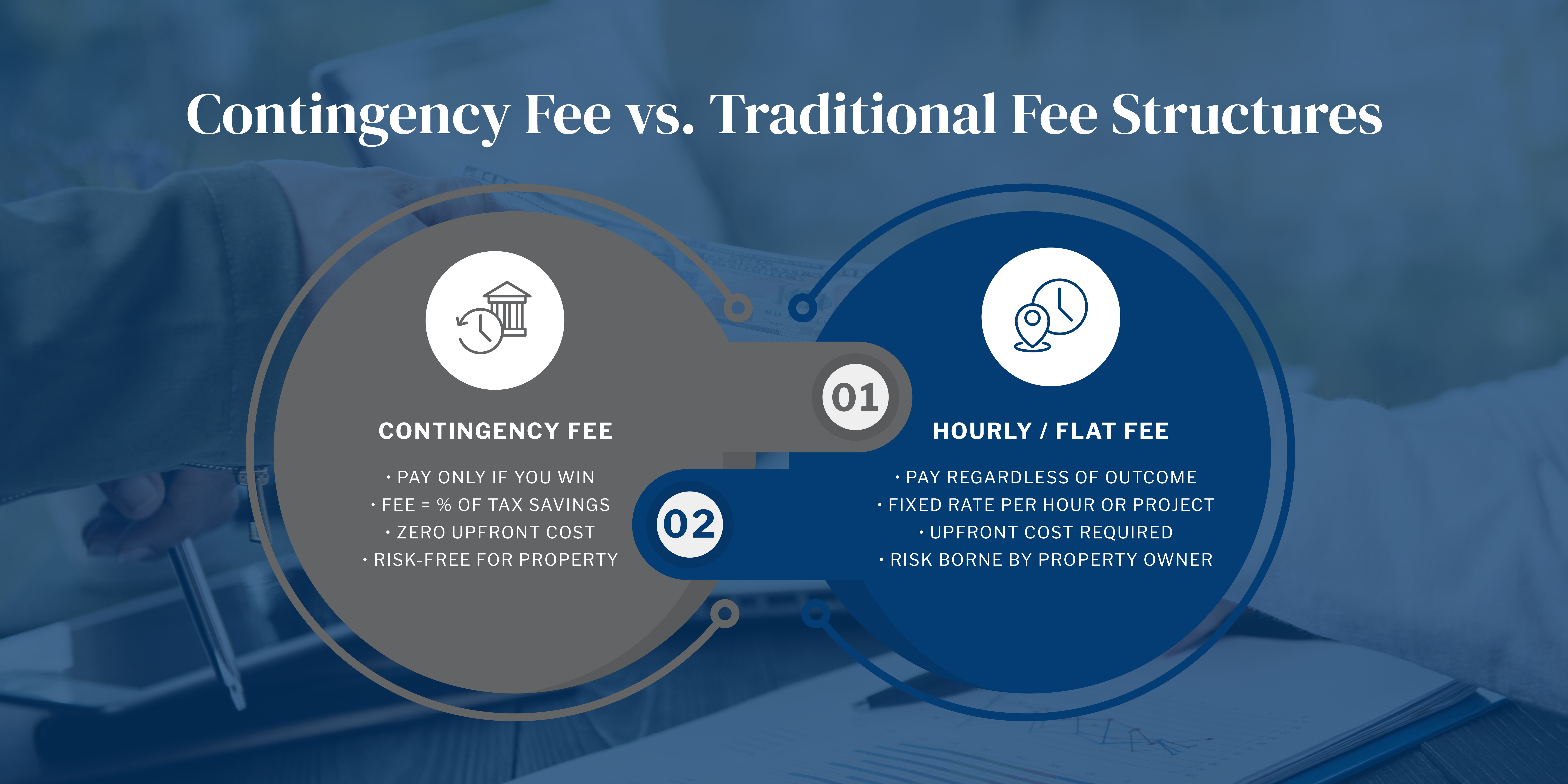
The right fee structure depends on your situation. Here is a direct comparison.
Contingency Fee: Best For
- Owners who want zero financial risk
- Cases where the outcome is uncertain
- Owners who do not have the budget for upfront professional fees
- First time appellants who are not sure whether their case is strong
Hourly or Flat Fee: Best For
- Very large, complex cases where the consultant's time investment is substantial and unpredictable
- Cases where the owner has high confidence in the outcome and wants to minimize the total fee paid
- Situations where the consultant is also providing other services, such as legal representation or appraisal, that are billed separately
For most commercial property owners pursuing a standard Proposition 8 or base year value appeal, the contingency fee model is the better choice. It aligns the consultant's incentives with yours, eliminates upfront cost, and removes the financial risk of an unsuccessful appeal.
What Does the Contingency Fee Cover?
A well structured contingency fee engagement should cover all of the following:
- Initial assessment review, analyzing your current assessed value and estimating potential savings
- Filing the appeal application, completing and submitting Form BOE-305-AH by the county deadline
- Evidence preparation, gathering comparable sales, income data, market vacancy data, and other supporting materials
- Informal review representation, presenting your case to the county assessor's staff before a formal hearing
- Formal hearing representation, appearing before the Assessment Appeals Board on your behalf
- Appraisal coordination, and if an independent appraisal is needed, a good consultant will either include this or arrange it at their cost
Always ask what is and is not included before signing. Some firms charge separately for appraisals or filing fees even on contingency engagements.
What to Look for in a Contingency Fee Agreement
Before signing any contingency fee agreement, review these key terms.
Fee percentage and calculation method. Is the fee based on first year savings only, or multiple years? Is it calculated on the reduction in assessed value or the actual tax savings? The difference matters.
Scope of representation. Does the agreement cover informal review, formal hearing, and any appeals to superior court, or only certain stages?
Exclusivity. Does the agreement prevent you from working with other consultants or representing yourself during the engagement period?
Term and termination. How long does the agreement last? Can you terminate it if you are unhappy with the consultant's work? What happens to pending appeals if you terminate?
Filing fee responsibility. Some counties charge a filing fee of $30 to $100. Clarify who is responsible for this.
Refund handling. If the appeal succeeds and you have already paid taxes at the higher rate, you will receive a refund from the county. Make sure the agreement is clear about how the consultant's fee is calculated relative to the refund.
Is a Contingency Fee Property Tax Appeal Right for You?
The contingency fee model works best when there is a meaningful gap between your assessed value and current market value, because that gap is what creates the savings that fund the consultant's fee.
Here are the situations where a contingency fee appeal makes the most sense.
Your property has declined in market value. If office, retail, or industrial values in your submarket have dropped since your last reassessment, there is likely a gap between your assessed value and current market value. This is the most common basis for a Proposition 8 appeal.
You recently purchased the property at a price that may not reflect full market value. If the purchase included significant business value, personal property, or other components that are not real estate and were incorrectly attributed to the real property, a base year value appeal may be warranted.
Your property has significant vacancy or below market rents. The income approach to value, which the appeals board uses for income producing properties, will produce a lower value when income is depressed. A consultant can build a compelling income based case.
You have never appealed before. Many commercial property owners have been overpaying for years without realizing it. A free evaluation from a contingency fee consultant costs you nothing and tells you whether there is an opportunity.
How to Evaluate a Property Tax Consultant Before Hiring
Not all property tax consultants are equally skilled or equally aligned with your interests. Here is what to look for.
Experience with your property type and county. A consultant who regularly works with office buildings in Los Angeles County will have much better knowledge of local comparables, assessor practices, and board preferences than a generalist.
Track record of results. Ask for examples of recent appeals they have handled, not just win rates but the magnitude of reductions achieved. A 5% reduction on a $1 million property is very different from a 20% reduction on a $10 million property.
Transparency about the process. A good consultant will give you an honest assessment of your case's strengths and weaknesses, not just tell you what you want to hear. Be wary of anyone who guarantees a specific outcome.
Clear, fair engagement agreement. The agreement should be straightforward, with no hidden fees or unusual terms. If it is confusing or overly complex, ask for clarification before signing.
References. Ask for references from other commercial property owners they have represented. A reputable firm will be happy to provide them.
Frequently Asked Questions
What percentage does a contingency fee property tax consultant typically charge?
In California, most contingency fee property tax consultants charge between 25% and 35% of the first year's tax savings. The exact percentage depends on the firm, the property type, and the complexity of the case. Larger or more complex cases may command a lower percentage.
Do I owe anything if the appeal does not succeed?
No. That is the defining feature of a contingency fee arrangement. You only pay if the appeal results in a reduction in your assessed value and corresponding tax savings.
Can I negotiate the contingency fee percentage?
Yes, particularly on larger properties. If your property has a high assessed value, the absolute dollar amount of the fee is substantial even at a lower percentage, which gives you negotiating leverage.
How is the contingency fee calculated, on the reduction in assessed value or the actual tax savings?
Most consultants calculate their fee based on the actual tax savings, meaning the reduction in assessed value multiplied by the applicable tax rate. This is the most straightforward and transparent method. Always confirm the calculation method before signing.
Does the contingency fee cover the cost of an independent appraisal?
It depends on the firm and the engagement agreement. Some firms include appraisal costs within their contingency fee, and others charge separately. Ask this question explicitly before signing.
Start With a Free Evaluation: No Risk, No Obligation
A contingency fee property tax appeal is the lowest risk way to find out whether you are overpaying on your commercial property taxes. The evaluation costs you nothing, the appeal costs you nothing if it fails, and the only cost if it succeeds is a percentage of the savings you have already received.
At Paramount Property Tax Appeal, we offer a free evaluation for every commercial property we review. We analyze your current assessment, estimate your potential savings, and tell you honestly whether we think an appeal is worth pursuing. We work exclusively on contingency, so our interests are aligned with yours.
Related Resources
- Commercial Property Tax Appeal California: The Complete Guide
- How to Appeal Commercial Property Taxes in California
- California Property Tax Appeal Deadlines: County by County Guide
- Understanding Proposition 13 for Commercial Property Owners
Sources: California Board of Equalization, Assessment Appeals FAQ · California Revenue and Taxation Code Section 1603 · California State Bar, Fee Agreements

.png?width=170&height=64&name=Logo%20320x120(2).png "Logo 320x120(2)")