
California Assessment Appeals Board: Filing, the Clerk of the Board and the Hearing
By Wes Nichols |
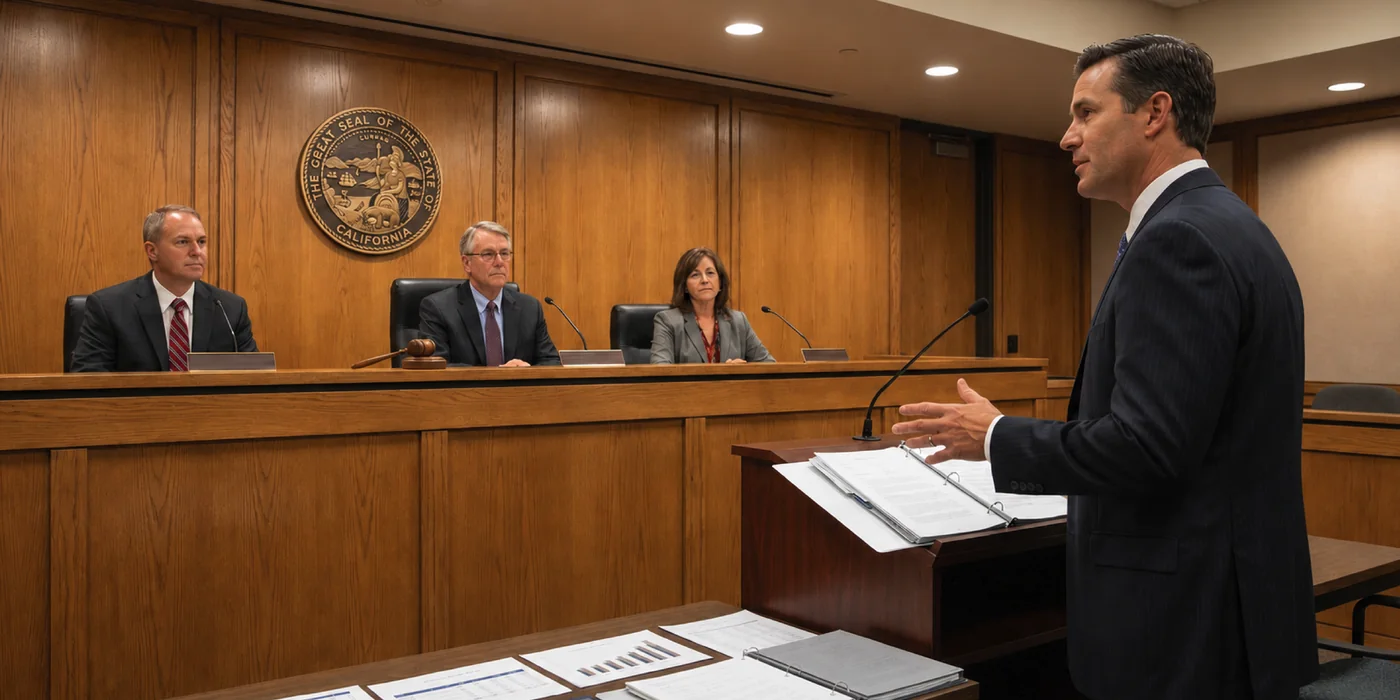
Every California property tax appeal is decided at the county level. The board that hears it is your county's assessment appeals board, not the State Board of Equalization, and the office that accepts your filing is the county Clerk of the Board. Owners who understand how those two pieces work file cleaner applications, avoid invalid filings, and walk into the hearing prepared for the burden they actually carry.
KEY TAKEAWAYS
- California assessment appeals are heard by a county assessment appeals board, a county board of supervisors sitting as the board of equalization, or a county hearing officer. The State Board of Equalization writes the rules and the form but does not hear local appeals.
- You file the BOE-305-AH Assessment Appeal Application with your county's Clerk of the Board, not with the assessor.
- The regular filing period runs July 2 to September 15, or to November 30 in counties where the assessor does not mail value notices to all secured owners by August 1.
- Commercial owners carry the burden of proof. The law presumes the assessor's value is correct until you show otherwise with independent evidence.
- Keep paying your taxes while the appeal is pending. A reduction comes back as a refund with interest.
What Is a California Assessment Appeals Board?
An assessment appeals board (AAB) is a county body that decides disputes over assessed value. Under the California Constitution, the county board of supervisors is the county board of equalization. A board of supervisors can hear appeals itself, or it can create one or more assessment appeals boards by ordinance to hear them instead (Revenue and Taxation Code section 1620). All 58 counties run assessment appeals proceedings.
The board acts in a quasi-judicial capacity. It decides each case only on the evidence presented at the hearing, and it can lower, raise, or confirm an assessed value. It does not have to choose either side's number. It reaches its own value from the evidence, applying the same valuation principles the assessor must follow.
There are also things an appeals board cannot do. It cannot grant or deny exemptions (other than classification questions), rule on tax rates or tax policy, consider your ability to pay, or extend a filing deadline.
Who sits on the board
AAB members serve three-year terms. In counties of 200,000 or more, which includes Los Angeles, San Diego, Orange and the other large commercial markets, a nominee needs at least five years of professional experience in California as a CPA or public accountant, licensed real estate broker, attorney, accredited or state-certified property appraiser, or appraiser certified by the State Board of Equalization (section 1624.05). Smaller counties may also appoint people with competent knowledge of appraisal and taxation (section 1624). New members must complete required training, and no one who worked in an assessor's office in the prior three years may serve.
A hearing needs a quorum, and a decision needs a majority of the members who heard the whole case. Either side can ask for the full board or a full three-member panel.
What Does the Clerk of the Board Do?
In most counties the clerk of the board of supervisors also serves as clerk of the assessment appeals board. The Clerk of the Board is where your appeal actually lives. The clerk:
- Receives applications and checks them for completeness, timeliness, and use of the proper form.
- Sends a copy of each accepted application to the assessor.
- Schedules hearings, assigns panels, and sends notices. You must receive written notice of your hearing at least 45 days in advance unless both sides agree to less.
- Flags invalid applications. An application missing required information is invalid. The clerk must tell you and give you a reasonable chance to correct it, and the board resolves any dispute over validity.
This is why the most common self-inflicted loss is not a weak argument. It is an application that was filed late, filed with the assessor instead of the clerk, or filed without a valid agent authorization.
The BOE-305-AH Assessment Appeal Application
The application form is the BOE-305-AH, Assessment Appeal Application. The State Board of Equalization prescribes it (section 1603), and before January 2015 it was called the Application for Changed Assessment. Counties issue their own printed versions of the state form. Los Angeles County's, for example, is its Form AAB-100. Counties must provide the form free of charge, although a county may still charge a filing fee.
What the application must include
- The applicant's name and address, and the agent's name and address if an agent is filing.
- The agent authorization, when an agent other than a retained California attorney files.
- A description of the property.
- Your opinion of value as of the valuation date, and the value on the roll.
- The facts you are relying on. The amount of the tax, or the size of an increase, is not enough on its own.
The application must be in writing and signed under penalty of perjury by the owner or person affected, an authorized agent, or a California-licensed attorney retained by the applicant. Electronic filing is allowed where the county accepts it, and many large counties now take applications online.
Who can file: owners, tenants, and agents
The person affected can file. That means anyone with a direct economic interest in paying the taxes for the valuation date, which includes the owner and a tenant whose lease requires it to pay the property taxes. For triple net commercial tenants, that can be the difference between having standing and not.
A corporation can file through an officer or an employee designated in writing to handle property tax matters. An agent, such as a property tax consultant, can file with written authorization. If the authorization is attached rather than on the form, it must state the date signed, the years covered (up to four consecutive years), the parcels covered, the agent's contact details, the applicant's signature and title, and a statement that the agent will give the applicant a copy of the application. For a corporation, LP or LLC, an officer or authorized employee must sign it. Retroactive authorizations are not allowed: the agent must be authorized when the application is filed.
You can amend an application until 5:00 p.m. on the last day it could have been timely filed. After that, only limited amendments are allowed.
When to File: The Deadlines That Control Jurisdiction
The board has no power to hear an application filed outside the periods the statutes allow. These windows are the whole game.
- Regular assessments: July 2 through September 15. The deadline moves to November 30 in any county where the assessor does not mail value notices to all secured property owners by August 1 (section 1603). Each county certifies its deadline every year. Check your county on our California property tax calendar.
- Weekends and holidays: if the deadline falls on a Saturday, Sunday or legal holiday, a filing mailed and postmarked on the next business day is timely.
- Supplemental and escape assessments: 60 days from the mailing date printed on the notice of assessment, or its postmark, whichever is later. In Los Angeles County, and in counties that adopt the option by resolution, the 60 days run from the mailing date on the tax bill instead (section 1605).
- No value notice in time: if you did not receive your value notice at least 15 days before the deadline, you may file within 60 days of receiving it, or 60 days of the tax bill mailing if earlier, with an affidavit.
- Calamity reassessments: appeal the assessor's proposed reassessment within six months of the notice's mailing date.
- Base year values: a base year value set by a change in ownership or new construction is conclusively presumed correct unless you appeal during the regular period for the year it is enrolled or one of the next three years (section 80).
An informal review does not stop the clock
Talking to the assessor first is worthwhile. Staff can correct errors without a hearing. But an informal review does not extend your filing deadline, and the board cannot extend it either. If the review has not produced a result you accept, file the application before the deadline. You can withdraw it later if the assessor fixes the value.
Decline in Value Versus Base Year Appeals
Most commercial appeals fall into one of two types.
A decline in value (Proposition 8) appeal argues that market value on January 1 was below the factored base year value. Taxable value is the lower of the two (section 51). A decline in value appeal covers one year only and does not carry forward, so you file again each year you disagree. Once the assessor reduces a value under Proposition 8, it must reappraise the property every year until market value climbs back above the factored base year value. See our guide to Prop 8 decline in value appeals.
A base year value appeal argues that the value set at purchase or new construction was wrong. A win applies to the appealed year and going forward, but not to earlier years. For a purchase, the price paid is presumed to be full cash value unless the evidence shows otherwise.
Before the Hearing: Exchange of Information
When the assessed value is over $100,000, either side can start a formal exchange of information (section 1606). The party that starts it sends its valuation data at least 30 days before the hearing, and the other side responds at least 15 days before. The data depends on the approach: comparable sales need parcel numbers, sale dates, zoning, prices and terms; an income approach needs income, expenses, and the capitalization method and rates.
The exchange has teeth. Afterward, neither side may introduce evidence on matters it did not exchange unless the other side consents. For an income-producing property, this is often where the case is won or lost.
How the Hearing Works
You must appear in person or through an agent who knows the facts thoroughly. A company appears through an officer, an employee, or its authorized agent. If no one appears after proper notice, the application is denied.
The party carrying the burden goes first. Testimony is under oath, and technical rules of evidence do not apply: relevant evidence is admitted if it is the kind responsible people rely on in serious affairs. The board cannot reduce an assessment unless the person affected or the agent attends and answers pertinent questions under oath, unless the board accepts a written stipulation signed by the assessor, county counsel and the applicant (section 1607).
The board may announce its decision at the hearing or take the case under submission. A written decision is due no later than 120 days after the hearing closes. The decision is final. The board cannot rehear it except to fix a clerical error or to relieve a non-appearance for excusable good cause.
Hearing officers
Counties may appoint hearing officers to hear smaller cases informally. Under the statewide default, a hearing officer can hear an application only if the applicant asks for one and the property is valued at $500,000 or less, or is a home, condo, co-op or building of four units or fewer. Counties can set different limits and decide whether a hearing officer's decision is a recommendation or final, so check your county's rules.
Who Has the Burden of Proof?
For commercial property, you do. The law presumes the assessor performed his or her duties properly, so the applicant must prove the roll value is wrong with independent evidence. Once both sides present evidence, the board weighs it all by a preponderance standard.
The statutory presumption in the taxpayer's favor (section 167) applies to owner-occupied homes and certain escape assessments. It does not cover commercial property. That is why commercial appeals are won with appraisal-grade evidence: comparable sales within 90 days of the valuation date, a supportable income analysis, and an independent appraisal where the stakes justify it. Our guide to evidence that wins a California appeal goes deeper.
The Two-Year Rule
If the board does not hear and decide a timely application within two years, the applicant's opinion of value on the application becomes the value taxes are based on (section 1604). It is not automatic. It does not apply if the applicant failed to provide required information or if related litigation is pending, and the applicant can waive it by agreeing to an extension. Postponement requests made close to the two-year mark often require exactly that kind of written extension. This is one reason your opinion of value on the application should be a number you can defend, not a placeholder.
After the Decision: Findings, Refunds, and Court
- Findings of fact: request written findings in writing before or at the start of the hearing, and pay any required fee before it ends (section 1611.5). Findings are needed if you may go to court. Fees vary by county.
- Refund claim: you can designate the application itself as a claim for refund. If you do not, the statute sets a separate, shorter deadline to file a refund claim after the board's decision (section 5097), so decide this at filing.
- Superior court: a suit to recover taxes the county refuses to refund is filed in superior court, generally within six months after the refund claim is rejected (section 5141). You must first go through the appeals board process and file a refund claim, and you can only recover on grounds stated in the claim.
- Keep paying: taxes are due on time while the appeal is pending, or penalties and interest apply whatever the outcome. A reduction is refunded with interest.
Frequently Asked Questions
Does the State Board of Equalization hear California property tax appeals?
No. Local assessment appeals are heard by the county assessment appeals board, the county board of supervisors sitting as the board of equalization, or a county hearing officer. The State Board of Equalization prescribes the BOE-305-AH form and writes the Property Tax Rules, but it does not hear local appeals.
Where do I file the BOE-305-AH?
With your county's Clerk of the Board, which serves as clerk of the assessment appeals board. Do not file it with the assessor. Many large counties accept the application online, and some charge a filing fee.
What is the deadline to file a California assessment appeal?
For regular assessments, July 2 through September 15, or through November 30 in counties where the assessor does not mail value notices to all secured owners by August 1. Supplemental and escape assessments have a separate 60-day window. Check your county's certified date each year.
Can a tenant appeal the property tax assessment?
Yes, if the lease requires the tenant to pay the property taxes. California's rules treat anyone with a direct economic interest in paying the taxes as a person affected, which includes a tenant under a lease that passes the taxes through.
Can the appeals board raise my assessment?
Yes. The board determines value from the evidence and is not limited by the applicant's opinion of value, so it can lower, confirm, or raise the assessment. That is why value should be analyzed before you file.
Do I have to pay my property taxes while the appeal is pending?
Yes. Pay on time to avoid penalties and interest. If the board reduces the value, the overpayment is refunded with interest.
What happens if the board does not decide my appeal within two years?
Generally, your opinion of value on the application becomes the value taxes are levied on, unless you agreed to extend the deadline, failed to provide required information, or related litigation is pending.
Why Work with Paramount Property Tax Appeal
At Paramount Property Tax Appeal, we file and present commercial and business personal property appeals before assessment appeals boards across California. We handle the application, the agent authorization, the exchange of information, and the hearing itself, and we build every case on appraisal-grade evidence.
We work on a contingency fee basis, so you pay nothing unless we reduce your assessment. Send us your assessment and we will tell you whether an appeal is worth filing.
Related Resources
- Commercial Property Tax Appeal California: The Complete Guide
- California Property Tax Calendar: County Filing Deadlines
- Los Angeles County Property Tax Appeal Guide
- How to Prepare for a Property Tax Appeal Hearing in California
- What Evidence Do You Need to Win a Property Tax Appeal?
Sources: California State Board of Equalization, Assessment Appeals · BOE Publication 30, Residential Property Assessment Appeals · BOE Property Tax Rules 301 to 326 · Revenue and Taxation Code section 1603 · section 1605 · section 1604
Topics: Appeal Process, Property Tax Appeals